Business
Invoice, receipt, quote or estimate: what's the difference?
Estimates, quotes, pro forma invoices, invoices and receipts look alike but do different jobs. Here's when to send each one and what each should show.

MD Rakib Shekh · Founder & Lead Architect
· 7 min read
On this page
A new client asks for a quote. Your accountant wants receipts. A customer needs "an invoice for the deposit" before they can pay. These documents look alike, but each one does a different job, and sending the wrong one can hold up a payment or leave a gap in your records.
Here's what each document is for, when to send it and what it should show.
This is general information, not legal advice. Tax rules on invoices and receipts vary, so check with your tax authority or an accountant for your country.
The short answer
| Document | When you send it | What it does | Asks for payment? |
|---|---|---|---|
| Estimate | Before the work, when the price isn't certain | Gives a best guess of the cost | No |
| Quote | Before the work, when you can fix the price | Offers a set price for set work, usually until an expiry date | No |
| Pro forma invoice | Before delivery or payment | Shows what the final invoice will look like | Not as a final bill; it's a preview |
| Invoice | When the work is done, or at an agreed stage | States what is owed, by when and how to pay | Yes |
| Receipt | After you've been paid | Confirms the payment was received | No |
Estimate
An estimate is your best guess at the cost when you can't be sure yet. Think of a repair where you won't know the problem until you open things up, or a project whose size depends on content the client hasn't sent.
An estimate should include:
- A clear description of the work
- The estimated cost, as a single figure or a range
- What could make the cost go up or down
- How long the estimate is valid
- The word "estimate", so nobody reads it as a fixed price
Quote
A quote, or quotation, is a price offer for a defined piece of work. Once the client accepts it, that price is what you've both agreed to, so make sure the scope is clear before you send it.
A quote should include:
- A quote number and date
- An expiry date, such as 30 days from the quote date
- The scope: what's included and what isn't
- A price breakdown, with any taxes
- Payment terms, including any deposit
- How to accept it, for example by signing it or replying in writing
People don't always use "quote" and "estimate" the same way, so say on the document whether the price is fixed. For bigger jobs, turn the accepted quote into a short contract. Our freelance contract checklist covers what to add.
Pro forma invoice
A pro forma invoice is a preview of the final invoice. Businesses use one when a buyer needs to see the exact figures first, for example to get internal approval, arrange payment in advance or prepare shipping paperwork.
Mark it clearly as "pro forma" so nobody books it as a real invoice. When the sale goes ahead, issue a proper invoice.
Invoice
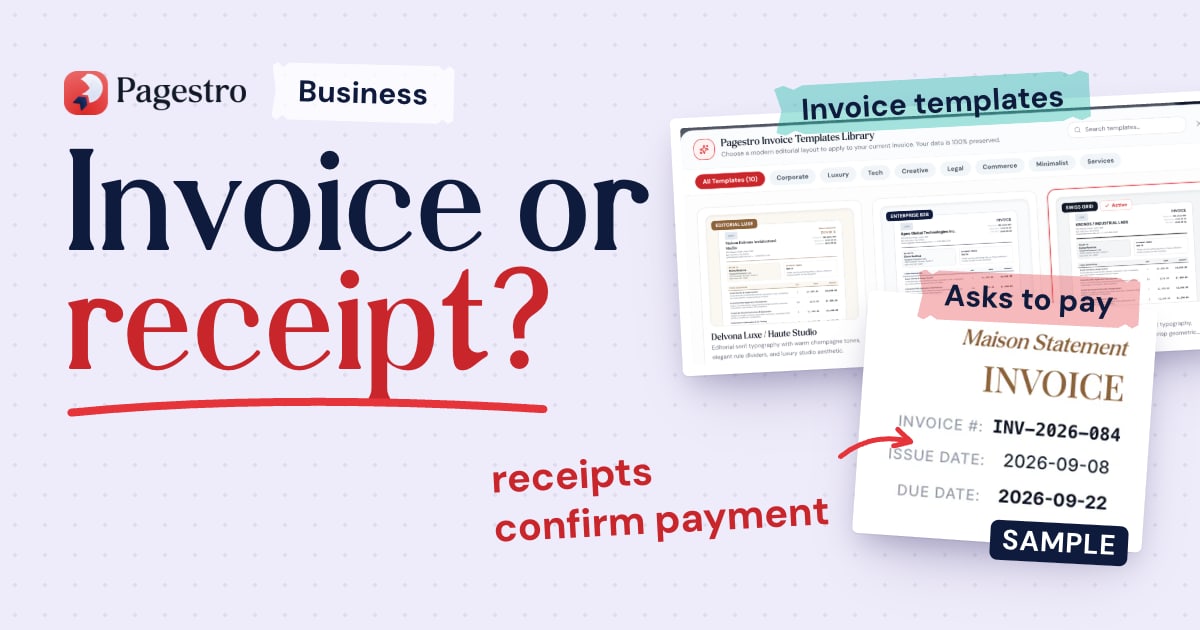
An invoice asks for payment for goods or services you've provided, or for an agreed stage such as a deposit. It's the document your client's accounts team needs before they can pay you, and the one you'll keep as a record of income.
An invoice should show a unique number, both parties' details, the date, what you're charging for, the amounts, any tax, the total due, the due date and how to pay. In the UK, GOV.UK sets out what an invoice must include. In the EU, VAT-registered businesses selling to other businesses normally issue VAT invoices that show their VAT number and the VAT charged. Our guide to writing an invoice that gets paid on time goes into the details.
Receipt
A receipt confirms that you've been paid. Customers use it as proof of payment, for their own records and for expense claims.
A receipt should include:
- Your business name and contact details
- Who paid, and the date of payment
- The amount and how it was paid
- What the payment was for
- A reference to the invoice it settles, if there was one
If a customer paid by card through a payment provider, check whether the provider already sends a receipt, so the customer doesn't get two different ones. For your own books in the US, the IRS lists both invoices and receipts among the documents that support your records. Keep copies of both.
How the documents fit together
A typical project might go like this:
Step 1. The client asks what it might cost. You send an estimate.
Step 2. Once the scope is clear, you send a quote with a fixed price and an expiry date.
Step 3. The client accepts, and you both sign a contract that sets out the scope and the payment terms.
Step 4. You send an invoice for the deposit, then another when the work is delivered.
Step 5. When each payment arrives, you send a receipt or mark the invoice as paid.
Not every job needs every step. A small fixed-price job might only need a quote, an invoice and a receipt.
Making these documents with Pagestro
Pagestro's Invoice Generator makes invoices, with 20+ templates, taxes, discounts and a pay-by-QR code. You can download a PDF or Word file without an account, or, with a free account, email the invoice and see when it's opened.
It doesn't have separate quote, estimate or receipt templates. A few practical options:
- Pro forma: add a custom watermark such as "PRO FORMA" across the invoice, so it can't be mistaken for the final one.
- Payment confirmation: enter the amount paid so the balance due shows zero, and add the "PAID" watermark. Many clients accept that as confirmation, but if your tax rules require a specific receipt format, use that instead.
- Quotes for larger work: the Statement of Work template in Contracts sets out deliverables, milestones and fees, and the client can sign it online.
Pagestro doesn't collect payments. Clients pay you directly using the details you put on the invoice.
Frequently asked questions
Is an invoice the same as a receipt?
No. An invoice asks for payment, and a receipt confirms that you've been paid. A paid invoice marked "PAID" can work as confirmation, but check whether your tax rules ask for a separate receipt.
What's the difference between a quote and an estimate?
A quote offers a fixed price for a defined scope. An estimate is a best guess that can change. Say clearly on the document which one you're sending.
Can I change a quote after the client accepts it?
Treat an accepted quote as the agreed price for that scope. If the work changes, send a revised quote or a written change and get it approved before you continue.
Do I have to send a receipt?
It depends on your country's rules and on what your customer needs. If a customer asks for one, send it promptly.
What is a pro forma invoice used for?
It shows a buyer the exact figures before the sale is final, for example so they can get approval or arrange payment in advance. It isn't the final bill; a proper invoice follows once the sale goes ahead.
- Invoicing
- Quotes
- Receipts
- Small business
Written by
MD Rakib Shekh
Founder & Lead Architect
Founder of Pagestro & UIXport. Specializing in WebAssembly browser tools, PDF processing, and high-performance design workflows.