Business
How to write a simple NDA: key clauses, types and a template
What goes into a simple non-disclosure agreement, when to use a mutual or one-way NDA, the rules that can limit one, and how to go from template to signed agreement.

MD Rakib Shekh · Founder & Lead Architect
· 7 min read
On this page
You're about to share something valuable: a business plan, source code, a client list or a product idea. Before you do, you want the other side to promise to keep it to themselves. That promise, in writing, is a non-disclosure agreement (NDA).
A simple NDA doesn't need to be long. This guide covers the clauses that matter, how to choose between a mutual and a one-way NDA, and how to go from template to signed agreement.
This is general information, not legal advice. Laws differ by country and state, so have a lawyer review any NDA that protects something important.
What an NDA does, and what it can't do
An NDA is a contract. The person receiving your information agrees to keep it confidential and to use it only for an agreed purpose, such as discussing a partnership or doing a project.
It has limits:
- It can't protect information that is already public.
- It doesn't stop someone from developing the same idea on their own.
- It's a promise you can enforce, not a lock. If someone breaks it, your remedy is through the courts.
- Some laws limit what an NDA can cover (more on that below).
So even with an NDA in place, share only what the other side needs.
Mutual or one-way?
| Type | Use it when | Example |
|---|---|---|
| One-way (unilateral) | Only one side shares confidential information | You hire a freelancer to work on an unreleased product |
| Mutual | Both sides share confidential information | Two companies explore a partnership |
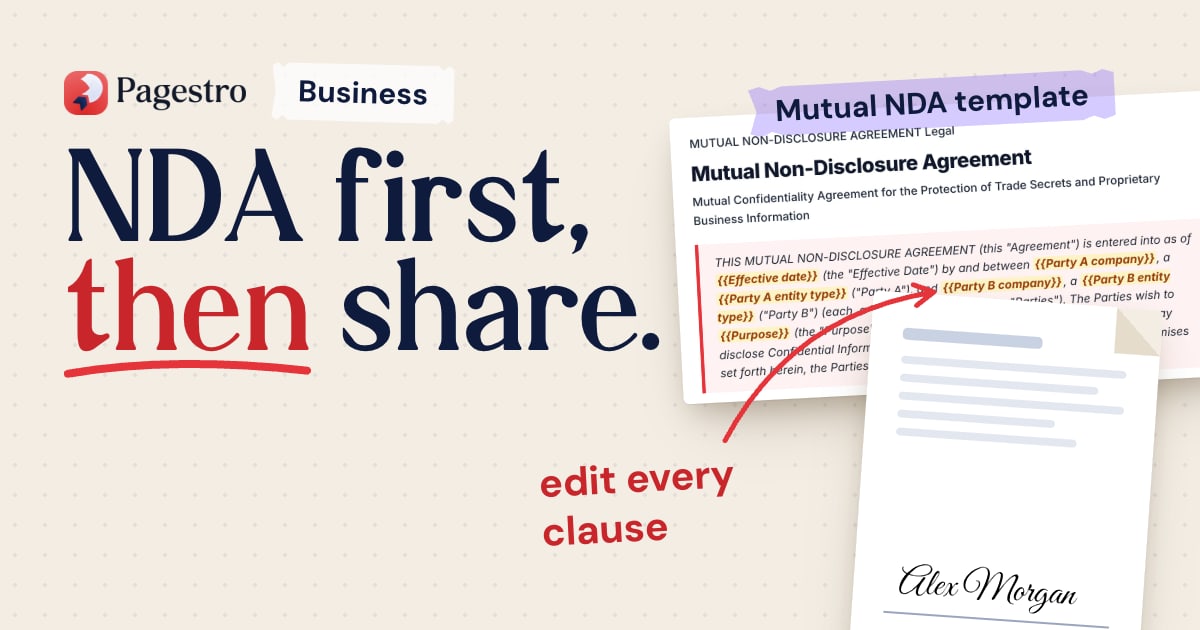
A mutual NDA can be easier to agree on, because both sides accept the same duties. Pagestro's NDA template is mutual. To make it one-way, edit it so that only your side is the disclosing party.
The key clauses in a simple NDA
Parties and effective date
Use full legal names: the company name as registered, not a brand name, or the person's full name if they're signing as an individual. Add the date the agreement starts.
Purpose
Say why information is being shared, such as "to evaluate a possible partnership". The receiving side may use the information only for that purpose.
What counts as confidential information
Define it clearly. A common approach covers information that is marked confidential, or that a reasonable person would understand to be confidential, such as plans, code, prices and customer lists. "Everything we ever tell you" is too vague to be useful.
Exclusions
Standard NDAs leave out information that is already public, that the receiver already knew, that they develop independently, or that they get lawfully from someone else.
Obligations
The receiver uses the information only for the purpose, protects it with reasonable care, and shares it only with people who need to know and are bound by similar terms.
Disclosure required by law
If a court or regulator orders disclosure, the receiver tells you first, where the law allows, and discloses only what is required.
How long it lasts
Set both the term of the agreement and how long the duty of confidentiality continues after it ends. Pagestro's template starts with a two-year term, confidentiality that continues for three years after that, and protection for trade secrets for as long as they stay secret. Adjust these to fit what you're sharing.
Return or destruction
When the agreement ends, or when you ask, the receiver returns or destroys your information.
No licence and no obligation
Sharing information doesn't give the receiver any rights to it, and neither side has to go ahead with a deal.
Remedies, governing law and signatures
Most NDAs let the disclosing side ask a court to stop a breach quickly, name the law that applies and where disputes go, and end with signature blocks for both parties.
Rules that can limit an NDA
Even a well-written NDA has to fit the law. Two US examples:
- Whistleblower notice. Under the Defend Trade Secrets Act, an employer must include a notice of whistleblower immunity in agreements with employees that cover trade secrets or other confidential information, and for this rule "employee" includes contractors and consultants. An employer that leaves it out can't recover certain damages and legal fees from that person (18 U.S.C. § 1833(b)). Pagestro's NDA template includes this notice.
- Speak Out Act. Under this law, signed in December 2022, nondisclosure and non-disparagement clauses agreed before a dispute arises can't be enforced by a court in sexual assault or sexual harassment disputes (42 U.S.C. § 19403).
Other countries and states have their own rules, especially for employees. That's one more reason to have a lawyer check NDAs you use with staff.
How to write an NDA from a template
Step 1. Open Contracts and choose the Mutual Non-Disclosure Agreement template.
Step 2. Fill in the parties, the effective date and the purpose.
Step 3. Edit the clauses you need to change: mutual or one-way, how long it lasts and which law applies. You can change any wording.
Step 4. Read it through as if you were the other side. Cut anything that doesn't apply.
Step 5. Sign it yourself and download it, or send it for signature. Sending needs a free Pagestro account, and the other person signs from an email link without an account. Pagestro keeps an audit trail of views and signatures and adds a completion certificate to the signed PDF.
The free plan includes the templates, signing documents yourself and a monthly allowance of signature requests. Paid plans include more requests, and Pro adds signing order and automatic reminders. See pricing for details.
If the other side sends you their NDA instead, read it carefully. If they only need your signature on a PDF, you can sign it in your browser with Sign PDF.
Common NDA mistakes
- Defining confidential information so broadly that nobody knows what it covers
- Leaving out the purpose
- Forgetting the standard exclusions
- Using a brand name instead of the legal name of the company
- No end date, or one that doesn't fit how long the information stays sensitive
- Adding a non-compete or non-solicitation clause without checking local law
When to call a lawyer
A template gets you a clear first draft. A lawyer makes sure it works where you are. Get one involved for NDAs with employees, deals that involve valuable technology or trade secrets, agreements across borders, and anything you'd be prepared to go to court over.
Freelancers working on a client's confidential project often handle confidentiality inside the main contract instead. Our freelance contract checklist covers that clause. For how online signatures hold up, read Are electronic signatures valid?
Frequently asked questions
Is an NDA signed online valid?
Electronic signatures are recognised for most agreements in many countries, including under the ESIGN Act and UETA in the US and eIDAS in the EU. Pagestro includes an audit trail with every signature request.
How long should an NDA last?
Long enough to cover how long the information stays sensitive. Trade secrets may need protection for as long as they stay secret, while a price list may only matter for a year or two.
Should I use a mutual or one-way NDA?
Use one-way when only you are sharing confidential information. Use mutual when both sides will share.
Is Pagestro's NDA template free?
Yes. All contract templates and signing documents yourself are on the free plan. Sending for signature uses your plan's monthly allowance of requests.
Do I need a lawyer to write an NDA?
Not always for a simple one, but have a lawyer review it when the information is valuable, when employees are involved, or when the other party is in another country.
- NDA
- Contracts
- Templates
- Small business
Written by
MD Rakib Shekh
Founder & Lead Architect
Founder of Pagestro & UIXport. Specializing in WebAssembly browser tools, PDF processing, and high-performance design workflows.