News
France e-invoicing since September 2026: what changes for you
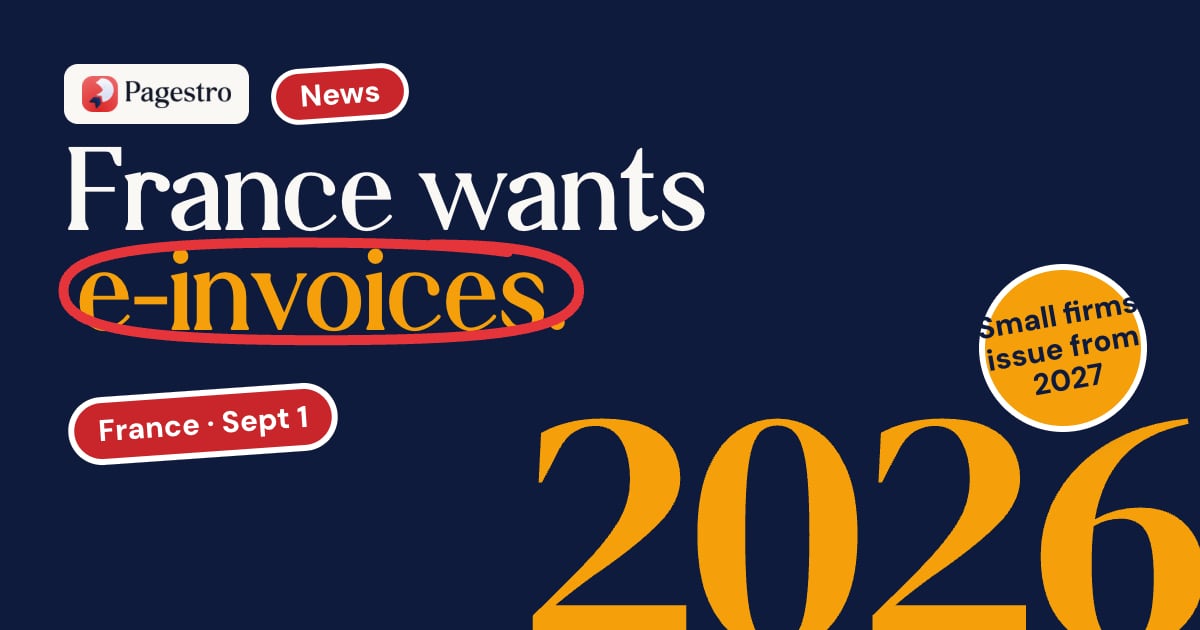
Since 1 September 2026 every French business must be able to receive e-invoices. Small firms must issue them from September 2027. Here is what applies, what does not apply to foreign freelancers, and what Pagestro cannot do.

MD Rakib Shekh · Founder & Lead Architect
· 7 min read
On this page
Since 1 September 2026, every company in France has to be able to receive e-invoices, and large and mid-sized companies have to issue them. Small and micro businesses start issuing on 1 September 2027. If you are a freelancer outside France, the French government says e-invoicing does not apply to you, but a different duty called e-reporting sometimes does.
This is general information, not legal or tax advice. The official starting point is the French tax authority's page on the reform (impots.gouv.fr). Everything below was checked against French tax authority pages on 31 October 2026.
What changed in France on 1 September 2026?
Two things began on that date, according to the tax authority's page on when the reform applies.
- Every company, whatever its size, must be able to receive e-invoices from suppliers who are required to send them.
- Large companies and mid-sized companies (ETI) must also issue e-invoices and send transaction and payment data to the tax administration.
Small and medium businesses and micro-enterprises are on the next step. They must issue e-invoices and send the same data from 1 September 2027.
The tax authority's FAQ, version of 1 September 2026 defines the sizes, measured on the last financial year closed before 1 January 2025. A micro-enterprise has fewer than 10 staff and turnover or a balance sheet of no more than EUR 2 million. A small or medium business (PME) has fewer than 250 staff and turnover of no more than EUR 50 million or a balance sheet of no more than EUR 43 million. Check which one your French client or your own French company falls into.
What counts as an e-invoice in France?
An e-invoice is a structured data file, not a picture of an invoice. The tax authority says a PDF made in an office tool or scanned, then sent by email, is not an e-invoice. It cites article 289 bis of the tax code: the invoice has to be issued and received in electronic form, carry a minimum set of structured data, and be sent through an approved platform (impots.gouv.fr).
Those approved platforms are the key detail. For invoices between French businesses, once the rules apply to you, you no longer send the invoice straight to your client. You hand it to your platform, and your platform passes it to your client's platform.
I am a freelancer outside France. Does this apply to me?
Probably not the e-invoicing part. The tax authority's FAQ says taxable persons not established in France are not covered by e-invoicing. Its page for foreign companies says e-invoicing, receiving and issuing, "does not apply" to foreign companies without a permanent establishment in France (impots.gouv.fr, foreign companies). One exception: the FAQ says a company based abroad that has a fixed establishment in France for VAT has the same duties as a French business.
E-reporting is the other duty. It means sending transaction data to the tax administration, through an approved platform. The FAQ says a business not established in France must e-report the transactions for which it is liable for French VAT. The foreign-company page gives examples: sales from France to another business not established in France, and sales to consumers where French VAT applies, unless you use the EU VAT One Stop Shop. Exports, intra-Community supplies, exempt transactions and imports are left out.
The usual freelancer case sits outside that list. The foreign-company page says a foreign company is not liable for French VAT when its customer is registered for VAT in France, and the French buyer then does the e-reporting. So if you are a freelancer in, say, Bangladesh or Canada billing a VAT-registered French company for services, the reporting falls on your client, not you. Confirm your own case with your accountant, and ask your French client what data they need from you.
The dates for foreign companies are 1 September 2026 for large and mid-sized ones and 1 September 2027 for the rest, with early starts allowed from 1 September 2026. The platform choice has to be made before the date that applies to you.
Is there a grace period?
Not a general one. The pages I read mention no tolerance period. The FAQ sets out the fines instead:
- EUR 50 per invoice not issued in electronic form, capped at EUR 15,000 a calendar year. The first offence is not fined.
- EUR 500 for a business that has not chosen an approved platform to receive invoices, three months after a formal notice from the tax administration. If it still has not, the fine becomes EUR 1,000 after each further three months.
If you hear about a wider grace period, ask for the official source before you rely on it.
Which should I choose?
| Your situation | What to do |
|---|---|
| French company, small or micro, invoicing other French businesses | Be able to receive e-invoices now. Choose an approved platform before 1 September 2027 to issue them. |
| French company, large or mid-sized | You are already in. Use an approved platform for issuing and for data reporting. |
| Freelancer outside France, invoicing VAT-registered French businesses for services | E-invoicing does not apply. Your client handles the e-reporting. Confirm with your accountant. |
| Anyone selling to private customers in France | Not e-invoicing. Those sales can fall under e-reporting, unless a foreign seller uses the EU One Stop Shop. Ask a French accountant. |
| Anyone who needs a PDF for a client who just wants a PDF | A PDF invoice is still fine as a document. It is not an e-invoice. |
What can Pagestro do here, and what can't it?
Pagestro's invoice generator makes PDF and Word invoices, and with a free account you can email the client a private link to the invoice. It does not create structured e-invoices such as Factur-X. It is not an approved platform and it does not send data to the French tax authority.
So if you are a French business in scope, Pagestro is the wrong tool for the invoice that goes through the platform. Use an approved platform or accounting software that connects to one.
Where Pagestro still fits:
- You invoice from outside France and the e-invoicing rules do not apply to you.
- You need a clean PDF for a client or a copy for your own records.
- You want to keep a finished PDF in the archive format. PDF to PDF/A does that in your browser. It does not turn the file into an e-invoice.
Pagestro does not collect payments either. Your client pays you directly using the details on the invoice.
For the wider picture across Belgium, Poland, Germany and the EU plan, see our guide to e-invoicing rules in 2026.
A short checklist
- Work out whether your business is established in France.
- If it is, find your size category and note 1 September 2026 or 1 September 2027.
- If it is not, read the foreign-company page and check e-reporting with your accountant.
- Ask your French clients how they want to receive invoices.
- Keep your own invoice copies in a safe, searchable place.
Frequently asked questions
Do French e-invoicing rules apply to a freelancer based outside France?
The tax authority says e-invoicing does not apply to companies without a permanent establishment in France. E-reporting applies to transactions where they are liable for French VAT. When the client is VAT-registered in France, the client reports instead.
When must small French businesses issue e-invoices?
From 1 September 2027. Since 1 September 2026 they must already be able to receive them.
Is a PDF invoice sent by email an e-invoice in France?
No. The tax authority says a PDF made in an office tool or a scan, sent by email, is not an e-invoice.
Can Pagestro send Factur-X invoices?
No. Pagestro makes PDF and Word invoices. It cannot create Factur-X files and it is not an approved platform.
What is e-reporting?
It is the sending of transaction data to the tax administration, through an approved platform. It is separate from sending the invoice itself.
- E-invoicing
- France
- Invoices
- VAT
- Freelancers
Written by
MD Rakib Shekh
Founder & Lead Architect
Founder of Pagestro. Specializing in WebAssembly browser tools, PDF processing, and high-performance design workflows.